This Is What Happens When You Slow Down in Oxford
You know that feeling when a place just stops you in your tracks? That’s Oxford. But here’s the thing—rushing through it on a tour bus or ticking off colleges in an hour? Total miss. I spent a week moving slowly, really seeing the stonework, archways, and silent courtyards. The architecture isn’t just old—it’s alive with stories. This is what happens when you let a city breathe, when you stop sightseeing and start feeling. Oxford, at walking pace, changes everything. It shifts your rhythm, softens your gaze, and invites you into a conversation with centuries of thought, craft, and quiet contemplation. This is not a city to conquer. It is one to inhabit, even if just for a few days.
Why Slow Travel Fits Oxford Perfectly
Oxford resists the checklist. Unlike destinations built for spectacle—waterfalls, skyscrapers, or sprawling ruins—Oxford’s power lies in subtlety. Its magic is not in scale alone but in detail, in the way morning light catches a weathered gargoyle or how the echo of footsteps in a stone passage feels like a whisper from the past. Most visitors arrive with tight schedules: a two-hour window between London and Bath, a guided tour that sweeps through three colleges in under an hour. They see the highlights—Christ Church Hall, the Bodleian, the Bridge of Sighs—but miss the silence between the stones, the rhythm of academic life, the way a college gate closes softly at dusk, sealing off centuries of tradition.
Slow travel, by contrast, allows Oxford to unfold. Staying for several days, walking the same streets at different hours, returning to the same courtyard when the light shifts—these practices transform sightseeing into presence. A college quadrangle at noon buzzes with tourists and students; at dawn, it is hushed, dew on the grass, the only sound a distant bell or the rustle of a gardener’s broom. That contrast is not just visual—it’s emotional. It alters your relationship to the place. You stop being a viewer and begin to feel like a witness.
The city’s academic soul also demands patience. Oxford is not a museum frozen in time; it is a living university, home to over 25,000 students and scholars. Lectures begin at 9 a.m., tutorials unfold in ancient rooms, and research continues behind ivy-covered walls. To move slowly is to align with that rhythm. It means sitting on a bench outside All Souls College and watching dons in academic gowns cross the square, not to photograph them, but to absorb the continuity of tradition. It means allowing yourself to get lost in the network of narrow alleys behind the Ashmolean, where the air smells of old paper and damp stone, and every doorway hints at a hidden garden or a private library.
Moreover, repetition deepens perception. Returning to the same spot—Magdalen Bridge at sunrise, the entrance to Exeter College at twilight—reveals changes invisible on a first pass. A carving you barely noticed now catches the low winter sun. A patch of moss has spread across a step. These small evolutions are the quiet heartbeat of the city. They teach you that architecture is not static. It breathes, ages, and responds to time. Slow travel makes you sensitive to that pulse.
The Language of Stone: Reading Oxford’s Architectural Layers
Walking through Oxford is like reading a book written in stone. Every building tells a story, not through words, but through form, material, and detail. The city is a palimpsest, where centuries of architectural styles overlap and converse. Gothic spires rise beside Neoclassical porticos; Tudor timber frames nestle between Victorian brick facades. Each style is more than aesthetic—it is a record of values, beliefs, and technological progress. To move slowly is to learn how to read this language.
Take the pointed arches and ribbed vaults of Gothic design, so prevalent in colleges like Merton and New. These were not chosen for beauty alone. They were engineering solutions—ways to lift walls higher, fill spaces with light, and direct the eye upward, toward the divine. The flying buttresses that brace many college chapels were revolutionary in their time, allowing for vast stained-glass windows that turned walls into radiant stories of faith. When you stand beneath one of these vaults, your neck craning, you are not just seeing stone and glass—you are experiencing a medieval vision of order, hierarchy, and spiritual aspiration.
Then there is the Tudor influence, visible in the black-and-white timber-framed buildings near the Covered Market. These structures, with their jettied upper floors and steeply pitched roofs, speak of domestic life in the 16th century. The woodwork was hand-hewn, the joints secured without nails. Each beam was carved to fit precisely, a testament to craftsmanship that valued patience and precision. Even now, running a hand along a centuries-old lintel, you can feel the tool marks, the slight imperfections that make the work human, not mechanical.
And then there is the detail—the part most tourists miss. Look closely at the grotesques perched on cornices: not all are demons or monsters. Some are scholars with books, others are animals mid-leap, frozen in stone. These were not mere decoration. In the medieval mind, they served as reminders of the world beyond reason—the wild, the unknown, the humorous. Similarly, inscriptions on lintels, often in Latin, speak of piety, learning, or the founding of a college. An iron gate shaped like ivy—seen at Brasenose College—carries symbolic meaning: ivy represents fidelity and endurance, clinging to walls as knowledge clings to the mind.
When you slow down, these details cease to be background. They become the text. You begin to see Oxford not as a collection of old buildings, but as a living archive, where every stone is a sentence, every arch a paragraph in a story that has been unfolding for nearly a thousand years.
Courtyards and Cloisters: Spaces That Breathe
If the streets of Oxford are its arteries, the college quadrangles are its lungs. These enclosed spaces—known as quads—are where the city exhales. Surrounded by stone walls, arched walkways, and leaded windows, they offer a profound sense of shelter and stillness. Most colleges have at least one quad, some have several, layered like Russian dolls. They are not designed for grandeur alone, but for contemplation, community, and the quiet rhythm of daily life.
The architecture of the quad is deeply psychological. By enclosing space, it creates intimacy. Even in a city of 150,000 people, stepping into a college courtyard can feel like entering a private world. The noise of traffic fades. The sky becomes a framed rectangle overhead. The grass, often meticulously maintained, invites bare feet in summer or quiet reading beneath an oak. At St John’s College, the First Quad is lined with 17th-century buildings, their mullioned windows glowing amber at sunset. At Corpus Christi, the smallest college, the quad is so tight it feels like a secret—known only to those who pause, look for the narrow entrance, and step inside.
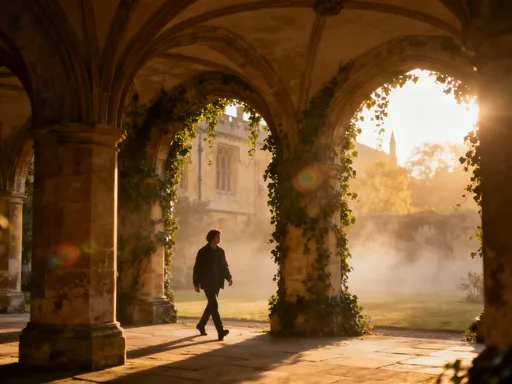
Cloisters, the covered walkways that often surround quads, enhance this effect. They provide shelter from rain, yes, but also a liminal space—between inside and outside, public and private. Walking a cloister at a slow pace, your footsteps echoing softly, you enter a meditative state. The rhythm of your steps matches the rhythm of thought. This was no accident. Monastic traditions influenced early college design, and the cloister was originally a place for silent prayer and reading. Even today, students use these spaces for quiet study, walking back and forth like philosophers in ancient Athens.
Greenery plays a crucial role. Many quads feature ancient trees—yews, oaks, or horse chestnuts—that have stood for centuries. Their roots intertwine with the foundations, their branches brushing against windows. At Magdalen College, the great lawn stretches toward the deer park, but even within the walls, trees rise from quads, their leaves filtering sunlight into dappled patterns on stone. Fountains, where they exist, add another layer: the sound of trickling water introduces a note of serenity, a counterpoint to the silence.
These spaces are not just beautiful—they are restorative. In a world of constant stimulation, the quad offers a rare commodity: undisturbed calm. To sit on a bench in Exeter College’s garden quad, watching a single leaf spiral to the ground, is to experience time differently. It slows. It deepens. It becomes personal. That is the gift of the courtyard—not just architecture, but atmosphere.
Beyond the Famous Faces: Hidden Architectural Gems
Every guidebook highlights Christ Church, the Radcliffe Camera, and the Bodleian Library. And yes, they are magnificent. But Oxford’s true architectural soul often lies off the beaten path, in places untouched by tour groups and selfie sticks. These are the spaces discovered not by following a map, but by wandering without agenda, turning down an alley because the light is right, or pausing because a door stands ajar.
One such place is the Oxford University Museum of Natural History. While many flock to its dinosaur skeletons, fewer notice the building itself—a masterpiece of Victorian engineering and design. The iron-and-glass vaulted ceiling, inspired by London’s Crystal Palace, floods the hall with natural light. The columns are not plain—they are cast iron, each one modeled after a different plant: palm, fern, lotus. This was no mere decoration. In the 19th century, science and nature were seen as divine expressions. The building itself became a sermon in structure, celebrating the order and beauty of the natural world.
Then there is Pusey House, a small but striking building on St Giles. Its exterior blends Gothic and Byzantine elements, with deep red brick, arched windows, and a copper dome that glints in the sun. Inside, the chapel is intimate, with rich woodwork and stained glass that casts jewel-toned light on stone floors. It was built as a center for Anglo-Catholic theology, and its architecture reflects that spiritual seriousness—dignified, solemn, yet warm. Few tourists enter, but those who do often linger, struck by the quiet intensity of the space.
St John’s College Chapel, while part of a well-known college, remains under the radar for most visitors. Its interior is a lesson in restraint and elegance. The stained glass, much of it Victorian, depicts scenes from the life of St John, but the real beauty lies in the proportions—the height of the nave, the curve of the apse, the way sound lingers in the vaulted ceiling. At evensong, when the choir sings, the acoustics make the space feel alive, as if the walls themselves are resonating with harmony.
And then there are the smaller joys: the 17th-century gatehouse at Wadham College, with its rust-colored stone and mullioned windows; the hidden garden behind Lincoln College, where a stream runs beneath an arched stone bridge; the clock tower at Wadham, designed by the same architect who worked on the Radcliffe Camera. These are not lesser sites—they are quieter ones. They ask not to be admired from a distance, but to be experienced up close, slowly, with attention.
Time as a Design Element: Light, Shadow, and Season
Architecture in Oxford is not fixed. It changes with the hour, the weather, the season. A building seen at noon in summer light reveals one face; the same structure at dawn in November mist shows another. To move slowly is to witness these transformations—to understand that time is not an enemy of old buildings, but a collaborator.
Light is perhaps the most dramatic actor. At sunrise, the golden limestone of the Radcliffe Camera glows like embers. By midday, it is bright, almost clinical. But in the late afternoon, when the sun slants low, the carvings deepen, shadows stretch across the facade, and the building seems to come alive with texture. Similarly, the spire of St Mary the Virgin Church, which rises above the Market Square, changes color throughout the day—from pale gray at dawn to warm ochre at sunset, then to a silhouette against a violet sky.
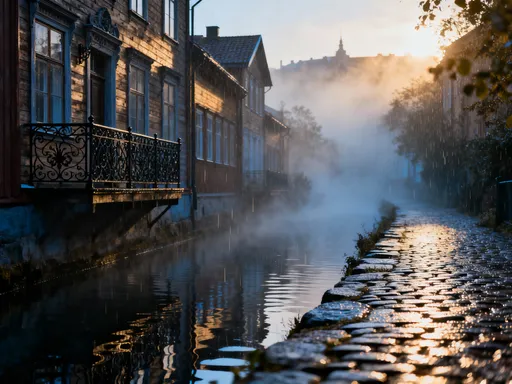
Fog plays its part, too. On damp mornings, mist clings to the spires, softening edges, muffling sound. The city feels dreamlike, suspended. Walking through Broad Street in such conditions is like moving through a painting—everything slightly blurred, slightly unreal. Rain, too, enhances the atmosphere. Cobblestones become slick mirrors, reflecting centuries-old walls. Water beads on carved faces, giving them a momentary expression—sadness, wisdom, surprise.
Seasons add another layer. In autumn, the trees frame archways with gold and crimson. At Magdalen Tower, the ivy turns deep red, clinging to stone like a living tapestry. In winter, frost dusts the ledges, and the breath of passersby rises in clouds. Spring brings blossoms—cherry trees in college gardens, daffodils along the Cherwell. Each season renews the city, reminding visitors that Oxford is not a relic, but a place that ages gracefully, season after season.
Returning to the same spot across days allows you to witness this evolution. A bench under an oak in University College’s garden may be empty one morning, then occupied by a reading student the next. A patch of moss grows. A leaf falls. These small changes are the quiet evidence of life continuing. They teach you to see architecture not as static, but as part of a living ecosystem.
Walking the Same Path Twice: Ritual and Connection
Most travelers pride themselves on covering ground—seeing as much as possible in as little time as possible. But in Oxford, the opposite approach yields deeper rewards. Walking the same path twice, even three times, builds intimacy. It turns observation into relationship. You begin to notice things you missed before: a crack in the pavement, a plaque you hadn’t read, a cat that suns itself on the same windowsill every afternoon.
Take Magdalen Bridge. Most cross it once, take a photo, and move on. But walk it at dawn, when the river is still, and the only sound is the dip of a rower’s oar. Cross it again at dusk, when the tower bells begin to chime. Each crossing reveals a different mood. The bridge becomes a character in your journey, not just a crossing point.
Or consider the gate of Balliol College. Seen from the street, it is imposing—stone, iron, Latin inscription. But return at different hours, and you see students rushing through in gowns, porters unlocking the door at 6 a.m., a visiting scholar pausing to read the plaque. The gate is no longer just architecture—it is a threshold, a point of passage, alive with human rhythm.
This repetition fosters a sense of belonging. You are not just visiting. You are becoming familiar. You start to anticipate the way light falls on a particular wall at 4 p.m. You know where the best bench is for watching the world go by. You develop a routine—coffee at the same café, a walk along the Thames Path, a stop at a favorite bookshop. These small rituals ground you. They make the city feel knowable, even if you’ve only been there a week.
And in that familiarity, you gain insight. You begin to see patterns—how certain streets are quieter on Tuesdays, how the library steps warm in the afternoon sun, how the sound of bells changes with the wind. These are not facts you can read in a guidebook. They are lived knowledge, earned through time and attention. That is the essence of slow travel: not seeing more, but seeing deeper.
How to Experience Oxford Like a Local (Without Pretending to Be One)
You don’t need to be a scholar or a resident to experience Oxford slowly. You only need curiosity, comfort, and a willingness to pause. Start with your feet. Good walking shoes are essential—Oxford’s cobbles are uneven, and you’ll cover miles without realizing it. Wear layers; the weather shifts quickly, and stone buildings stay cool even in summer.
Choose your timing. The city is busiest between 11 a.m. and 3 p.m., when tour groups arrive. Visit major sites like the Bodleian or Christ Church early in the morning or late in the afternoon. You’ll have space to breathe, to look up, to listen. Mornings are especially magical—fog in the quads, light on the spires, the city waking up.
Find places to sit. Benches in college gardens, if open to visitors, are ideal. So are the grassy banks along the Cherwell or the stone steps outside Blackwell’s Bookshop. Bring a notebook, a thermos, or just your thoughts. Stay for an hour. Watch. Listen. Let the city settle around you.
Respect the spaces. Many college quads are open during the day, but some close in the evening or during exams. Follow signs, avoid loud conversation, and never wander into private areas. You don’t need access to every room to feel connected. Sometimes, standing quietly outside a gate, observing the light in a courtyard, is enough.
Wander without a map. Let yourself get slightly lost in the alleys behind Cornmarket or along the riverside paths. Some of Oxford’s best moments happen off-script—a hidden garden, a sunlit archway, a street musician playing near the Covered Market. Follow your curiosity, but not at the expense of presence. Put your phone away. Look up. Notice the details.
And finally, return. If you can, visit Oxford more than once. Let it become a place you grow with. Each return will reveal something new—not because the city has changed, but because you have. Your eyes are sharper. Your pace is slower. Your heart is more open. That is how Oxford reveals itself: not all at once, but over time, to those who are willing to walk slowly, look closely, and listen to the stones.
Oxford’s architecture isn’t meant to be consumed—it’s meant to be lived with. When you slow down, the stones start to speak, the arches pull you in, and the city reveals itself not as a monument, but as a breathing, evolving presence. This is the heart of slow travel: not seeing more, but seeing deeper. Let Oxford teach you how to look.